3D Chinese Auspicious Cloud Patterns
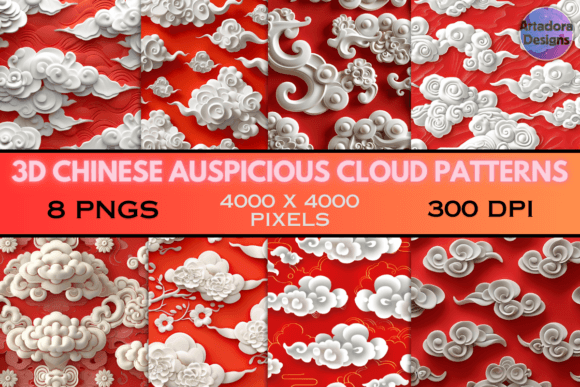
The 3D Chinese Auspicious Cloud Patterns collection represents a specific category of digital design assets that blend traditional Oriental aesthetics with modern three-dimensional rendering techniques. This resource is designed for professionals and hobbyists seeking to incorporate elements of Asian heritage into contemporary projects without sacrificing visual depth or realism. The pack consists of eight distinct patterns, each rendered at a high resolution of 4000×4000 pixels. These files are provided in PNG format within a single ZIP archive, totaling approximately 218 MB. The primary value proposition lies in the intricate detailing of the clouds, which are crafted to evoke serenity and elegance while maintaining the structural complexity associated with 3D modeling.
Understanding the Design Philosophy
Traditional Chinese cloud motifs, often referred to as "ruyi" clouds, have been a staple in art and architecture for centuries, symbolizing good fortune, longevity, and spiritual ascension. The 3D Chinese Auspicious Cloud Patterns collection reinterprets these symbols through a modern lens. Unlike flat vector graphics, these designs utilize shading, lighting, and texture to create a sense of volume and movement. This approach allows the patterns to appear dynamic rather than static, making them suitable for applications where visual impact is paramount.
The collection includes eight diverse variations. While they share a common thematic root, each design offers a unique arrangement and textural quality. Some may feature softer gradients to emphasize serenity, while others might use sharper contrasts to highlight the geometric precision of the Eastern aesthetic. This variety ensures that users can select a pattern that aligns specifically with the mood of their project, whether it requires a subtle background texture or a bold focal point.
Practical Applications and Use Cases
The versatility of these high-resolution assets makes them applicable across a wide spectrum of industries. Because the files are delivered as transparent PNGs, they offer significant flexibility regarding layering and compositing. Below are several practical scenarios where this collection serves as a strong fit:
- Print on Demand (POD): The patterns are ideal for All-Over Print (AOP) applications. Users can apply the designs to clothing, tote bags, and home decor items. The high resolution ensures that when printed on large surfaces, the details remain crisp without pixelation.
- Stationery and Greeting Cards: For designers creating wedding invitations, Lunar New Year cards, or premium notebooks, these clouds add an immediate sense of cultural sophistication. The 3D effect adds a tactile feel to the visual design, even before printing.
- Digital Media and UI Design: Web designers and app developers can utilize these assets for landing pages, social media backgrounds, or presentation slides. The ability to overlay the clouds on solid colors or other images allows for creative composition that breaks away from standard flat design trends.
- Merchandise Branding: Small business owners looking to differentiate their brand can use these patterns on packaging, stickers, and mugs. The auspicious nature of the imagery can also serve as a positive branding element for businesses targeting markets interested in wellness or spirituality.
Technical Considerations and Workflow
While the asset pack is robust, successful integration requires a specific workflow. The 218 MB file size indicates high-quality data, which necessitates sufficient storage and processing power. When importing these 4000-pixel images into design software like Adobe Photoshop, Illustrator, or GIMP, users should be prepared for larger file sizes during the editing process.
To maximize efficiency, the documentation suggests using pattern checkers. These tools allow users to preview how the individual cloud designs repeat seamlessly. Creating a seamless repeat is crucial for AOP and textile applications; if the edges do not align perfectly, the final product will show visible seams. Utilizing a checker tool helps identify misalignments before the design is finalized or sent to print.
Furthermore, the use of POD platforms can streamline the evaluation process. Many print-on-demand sites offer a "pattern" function that simulates how the digital file looks on physical products. This step is highly recommended for commercial projects, as it helps visualize scale and color accuracy. It bridges the gap between the digital workspace and the physical reality of the final product, reducing the risk of costly errors.
Evaluating Tradeoffs and Limitations
Before committing to this collection, it is important to weigh the benefits against potential limitations. The primary advantage is the ready-made nature of the assets; users save time on manual illustration. However, this convenience comes with constraints regarding customization.
Lack of Editability: Since the assets are provided as raster images (PNG), they are not easily scalable beyond their original dimensions without losing quality. Unlike vector formats (SVG or AI), users cannot simply resize the clouds to fill a billboard without risking blurriness. Additionally, changing the color of the clouds requires complex selection and recoloring processes, which may be more labor-intensive than starting with editable vector layers.
File Management: The requirement to unzip a 218 MB folder and manage eight separate high-resolution files can be cumbersome for users working on slower machines or those with limited storage space. It is essential to ensure that the hardware can handle the load of multiple 4000×4000 pixel images simultaneously.
Cultural Context: While the designs are aesthetically pleasing, users must ensure that their application respects the cultural significance of the imagery. Using auspicious symbols inappropriately or in contexts that contradict their meaning could lead to reputational issues. The designs should be used with an understanding of what they represent to maintain authenticity.
Decision-Making Insights
When determining whether the 3D Chinese Auspicious Cloud Patterns aligns with your goals, consider the following criteria:
- Resolution Needs: If your project requires large-format printing (e.g., banners, fabric rolls), the 4000-pixel resolution is likely sufficient. For web-only use, the images may be overkill and require downsizing, which negates some of the quality benefit.
- Customization Requirements: If you need to alter the shape or color of the clouds extensively, this raster-based pack may not be the best choice. In such cases, hiring a designer to create custom vectors or purchasing a vector-based cloud set might be more efficient.
- Speed vs. Control: If speed is the priority and you need a professional look immediately, this pack is an excellent solution. If you require total control over every element of the design, the lack of vector editability may be a hindrance.
In conclusion, this collection is a valuable resource for designers who appreciate the fusion of traditional Eastern motifs with modern 3D rendering. It is particularly well-suited for Print on Demand businesses, stationery creators, and digital artists looking to add depth and cultural resonance to their work. By understanding the technical requirements and leveraging tools like pattern checkers and POD simulators, users can effectively integrate these assets into their workflows. However, those requiring extensive manipulation of the design elements or working with strict vector-only workflows may find alternative solutions more appropriate.